
By signcraft
Posted on Saturday, February 14th, 2026

The basis for knowing what to charge for your signs is knowing what it costs for you to operate your shop for each hour of production time. That’s the minimum rate the shop must charge for production time so that their expenses (sometimes called overhead or indirect costs) are covered.
These indirect costs are there whether the shop makes a sign today or not. (Direct costs are those that relate to producing a specific sign—such as paint, vinyl and substrate.) You need a way to recover your indirect costs by spreading them across all of the jobs you do, and your hourly rate is one of the easiest ways to make that happen.
If you don’t already know your overhead, the Overhead Worksheet provided here will help. It’s designed for the typical sign shop and covers the key overhead areas.
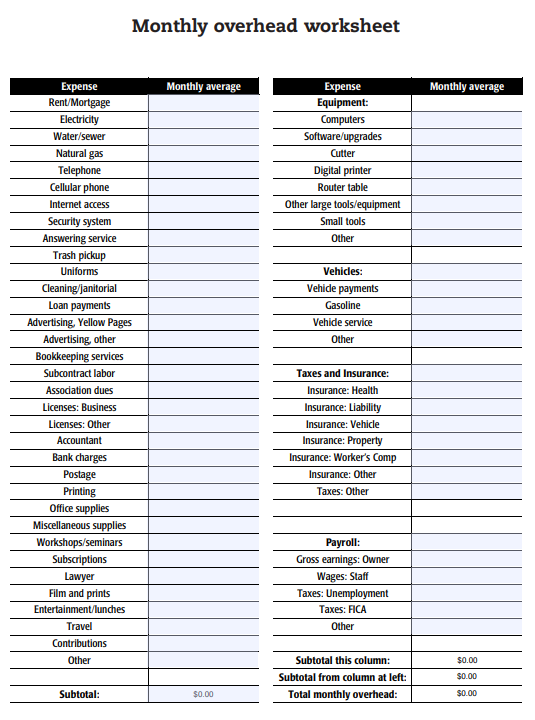
Click here to download a PDF form you can fill out and print.
It takes a little research into what things are costing you, but the result can be surprising—even if unpleasant. Even so, these numbers are the cold hard facts required for your shop’s survival.
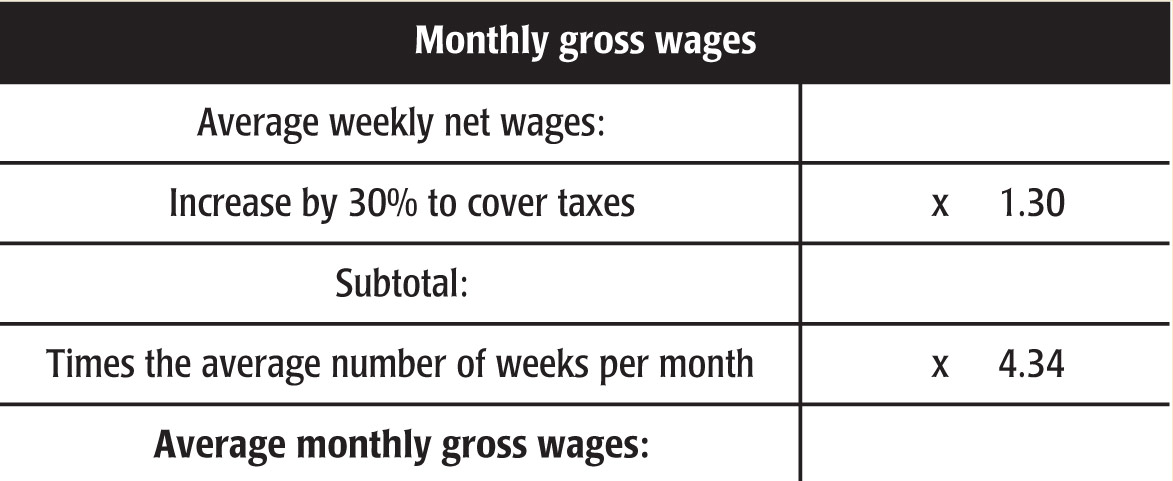
When you enter your monthly wage, remember that this is before self-employment and income taxes. If you know what you need to net and want a rough estimate of what your gross salary should be, add 30 percent to the net and use that as your weekly gross. If your business is a corporation, your wages will be handled as if you were an employee. See your accountant if you’d like a more exact estimate of your taxes.
Using the Overhead Worksheet
As you use the Overhead Worksheet to determine your monthly overhead, keep these points in mind:
■ Gross Earnings: These are your total earnings before any taxes are paid. Use the Determining your monthly gross wages worksheet to get the number for your gross monthly earnings.
■ Remember that the value of most computer hardware drops to just about nothing in three years. If you paid cash for hardware (rather than leasing it) divide the total by 36 months and put that figure in for your monthly cost. That way you’ll have the money to replace it when the time comes.
■ If you have a home-based shop, you still have “rent” to pay. It won’t be as much as commercial space, but you’re providing the space and utilities needed for your business to operate. Otherwise your overhead savings benefits only your customer—not you. Besides, if circumstances change and you need to rent commercial space, you won’t have that built into your pricing.
■ Knowing your expenses is essential. The only items you can leave blank on the worksheet are those that you are sure you do not incur during the year. If not, you’re only fooling yourself.
Determine your gross and hourly wages
Accountants, small business consultants, the US Small Business Administration—all agree that business owners who pay themselves a weekly paycheck are more likely to succeed than those who live on a feast-or-famine cycle based on when checks come in. A regular paycheck helps stabilize your cash flow and keeps your expectations realistic.
There are 52 weeks in a year, which averages out to 4.34 weeks per month. (Yes, we all say there are 4 weeks in a month, but that only comes out to 48 weeks per year.) Multiply your weekly gross salary by 4.34 and enter that as your own monthly gross wages. Here’s an example. Say you need to net $1500 per week. Add 25 percent to cover taxes and you get weekly gross wages of $1875. Multiply that by 4.34 and you get average monthly net wages of $8738.
Next, add up your monthly expenses. Multiply that by 12 and you have your annual overhead. Now you’re ready to turn that into your hourly rate. But first you need to know how many billable hours you average per week. It’s essential to accurately estimate this number.
Billable hours
A portion of every day is absorbed by tasks essential to your business but not connected to producing any particular sign—talking to prospects, answering the phone, paying bills, ordering materials. They are part of being in business, but they usually can’t be billed to a specific job. The cost for this time must be distributed over all your production time.
The hours of actual production time are called billable hours. That’s the number of hours per week that you’re able to actually make signs. Depending on your business, your billable hours may be as little as 20 hours a week. The only way to know this for sure is to track your production hours and total work hours for a typical week.
That’s not all that difficult—it just takes a little discipline to jot down what time you start and end the workday, and how much time you spend doing production work that customers are paying for—actually making the signs. Try it for a week.
Few of us are as productive as we’d like to be. The distractions and interruptions are inevitable. It’s unrealistic to believe that you, as a shop owner, can do actual production eight hours a day, every day. That time that you cannot bill to actual sign production, yet is essential to running your business, has to be factored into your pricing. Without knowing your billable hours, you’ll probably spend a lot of evenings and weekends making up the time you’re not charging for during the workday.
So let’s say you spend about 15 hours per week dealing with customers, making sales calls, running errands, ordering materials and so on. Assuming a 40hour workweek, that leaves you with 25 billable hours per week.
Let’s say you want three weeks off for vacation/sick time each year. That leaves you with 49 production weeks per year. Multiply 25 hours per week times 49 weeks and you have 1250 billable hours per year.
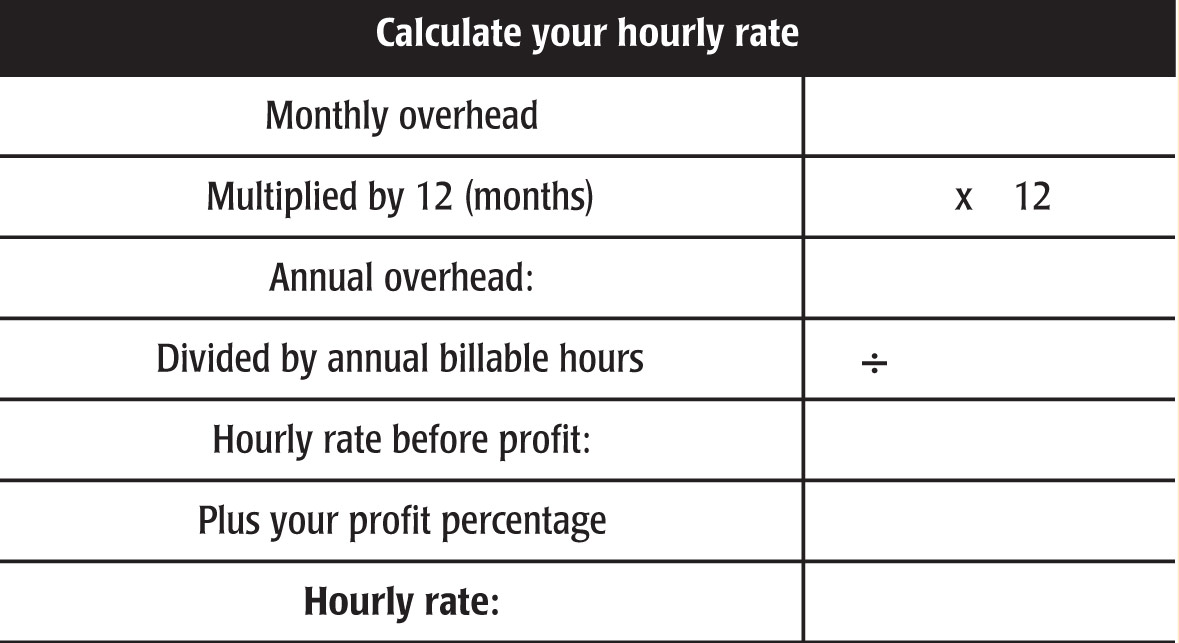
Once you have determined your monthly overhead, billable hours and your desired monthly wages, you can calculate your hourly shop rate. Yes, all this takes a little time and effort, but the result is being able to estimate the selling prices for your signs with confidence—knowing that your income needs are met and that your business’s chances of survival are high. Wild guestimates of your expenses and overhead are a waste of time if you want to price your work accurately and effectively.
Finally, don’t forget material markup and profit
To accurately price a sign, you must multiply your estimate of the hours it will take to produce it and add in the cost of the materials used—with the appropriate markup. Markup is an increase in the actual cost of materials to cover waste, handling and the cost of having money invested in inventory. The amount of markup among the shops we have surveyed ranges from 33 to 100 percent.
Owning a small business is risky—less than 50% survive to see their fifth anniversary. Your company is subject to the ups and downs of the marketplace. Your livelihood depends on your ability to work efficiently and effectively. This involves more commitment than is expected from an employee. Profit doesn’t just happen—it must be built into your pricing.
Say your hourly rate at this point comes to $100. If you feel that 20% is a fair profit, add that in. You’re at $120 per hour. The end result is an hourly rate you can live with and that you know is realistic. Your prices won’t be based on a guess of what the shop down the street is charging. You’ll have a good idea of what you need to charge to keep your doors open.


