By signcraft
Posted on Monday, March 23rd, 2026

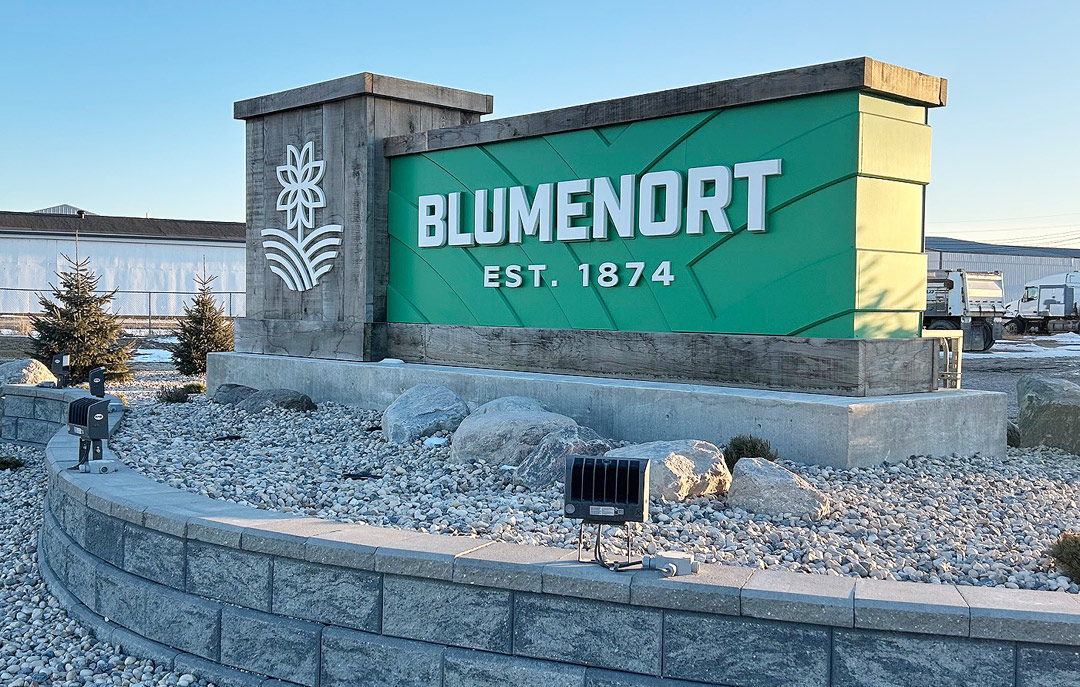
Even though you can’t see it in the photo of the completed sign, every sign has a backstory—the issues the sign designer has to deal with or work around, along with the products and materials used to create it. We asked RT Signs, Steinbach, Manitoba, Canada, how this large welcome sign for a nearby community came together:
This municipality came to us with a drawing and asked for a quote for the job, which they were putting out for bid. We had an idea that we felt would look better, so we gave them two bids—one for their design and one for ours. The prices were relatively close, so they went with our version because it was stronger.
It’s a single-face sign that is 20 ft. wide overall. This sign was replacing a billboard and was up on a grade that would be landscaped. The municipality bids out all projects, so the sign and landscaping, which included the block retaining wall, were separate bids. We did the sign and the lighting.

The design: Our layout is quite different from the drawing that they brought to us. We used Teko Bold for the main copy and Syncopate for “Est. 1874.” The “Blumenort” letters are formed plastic from Gemini Sign Letters, and the secondary copy was cut from 1-in. PVC board.
The flower graphic on the wood pillar is the community’s brand, which was developed by another local designer for the town a few years ago. It’s cut from 1-in. PVC board.
The design for the background picked up the “fields” in the lower portion the logo. It gives some added texture and dimension to the background.
The structure: The wood pillar is 6-ft. tall. It was built from 3-by-12-in. oak planks over a wood structure. The lower trim is also 3-by-12-in. and top trim is 3-by-6-in. oak. The shapes in the green background panel were router-cut from 1-in. PVC board and attached to a panel of .080 aluminum with clear silicone adhesive and screws from the back. The sign sits on a very thick concrete slab that we had poured by a contractor.
Finishes: The painted portions were finished with Benjamin Moore Corotech Command, which is a single-component, waterborne acrylic urethane enamel. We treated the oak with Lifetime Wood Treatment, which speeds oxidation and gives a uniform color to the wood. The wood turns to a very nice weathered silver gray color.