
By Dan Antonelli
Posted on Friday, December 19th, 2025

The business of sign shops is a visual one—one that years of experience has shown how to best integrate brands on outdoor advertising. But the average customer is not usually very visual. Most have a difficult time understanding the concept of a brand or brand integration. Most are very skilled in running their business but have very little expertise when it comes to marketing a business.
The biggest mistake sign companies make in their own marketing is assuming that their target audience understands not only what they sell, but why what they sell is important to them. If you look it over, much of the marketing material for a sign shop usually talks about product lines. That’s fine if you assume the prospect knows exactly what they need. But do photos of banners, trucks or signs tell the real story about why your work is superior?
Too much of the focus is typically on why you may think you’re so special. Maybe you’ve won awards. Or written some articles. Or have a terrific office. All nice things, for sure. But at the end of the day you need to address one simple thing: how do all these assets translate into success for your customer? How is your “greatness” going to solve their problems?
Each prospect comes to you with a problem—more specifically, a marketing or advertising problem. It may be described in a different manner, like “Hey, I need a [sign, truck, banner]….”
Between the lines of their request is the need for you to solve their problem. Where so many shops go wrong is assuming that their “greatness” identifies to the prospect how they are going to solve their problem. It doesn’t. It only serves as a tool to leverage in establishing credibility.
Instead, what should be done is to leverage your past successes for people just like them with similar problems. In approaching your marketing this way, you can clearly show how your work has solved problems for companies that are similar to theirs. When you frame your service offering in this manner, you speak to the prospect more directly because they see themselves first, and how you can help second.
Consider it from this mindset: all clients care about are themselves, first and foremost. Clients don’t care about how great you are. All they truly care about is how your “greatness” will help transform them into a more successful company.
Use case studies to market your products
To frame your marketing message in the proper context, lead the conversation to addressing their problem. Instead of “We make beautiful, colorful banners that last”, try “Our beautiful banners are designed to attract attention and help your business close more sales. Learn how (click).” Then lead clients to a page with relevant examples from business owners, along with testimonials.
Instead of “Full color truck wraps designed to last with quality vinyl” try, “Learn how our truck wraps increased business for XYZ company (click).” Then lead them to a page that describes the vehicle, quotes the owner, and explains what your design has done to solve their marketing challenges.
Branding case studies
If you are a sign shop trying to sell more design as a specific line item, it’s crucial that you leverage case studies to identify and help clients visualize what an actual brand might be. I’ve written previously about selling branding and how case studies can help a client understand the concept better. They may not know what a brand is, but if you show them a truck wrap, a site sign, a freestanding sign, a set of stationery, uniforms for their employees and equipment stickers—all with one unified brand message—suddenly it’s much easier for them to “get it.”
Not only can they visualize a brand at work, but the case study itself should speak to how this new cohesive brand has helped that client grow their business. Typically, we like to write a narrative for each case study which speaks to that client’s specific challenge, and how we tackled and solved their problem. We end the page with a relevant quote from the business owner.
This shows a prospect someone just like them, and how you solved that company’s problem. Basically, most marketing problems for small businesses are the same. You just showed what you did for another company could also work for theirs. Now, your “greatness” becomes icing on the cake. You solve problems—and you’re award-winning, published, etc. You can’t illustrate better qualifications in their minds.
Investing the time pays off
So why don’t most sign companies market themselves this way? For one, it’s a lot of work. You have to spend time preparing your marketing, interviewing clients, preparing the artwork for your case studies. All this work, though, is an investment in your marketing assets. You have to continue to invest in your own marketing in order to achieve the best return on investment. You have to commit to the process.
Once you’ve achieved a solid foundation of successes to illustrate, it becomes harder for prospective clients to compare your shop to another commodity-based shop. Your shop is now focused more on the marketing of small businesses, and your products are merely the tools you use to get there. It becomes less about time and materials or cost per square foot. You’re an advocate for their success, which is very different than most sign shop models that deploy a churn-and-burn mentality.
While the day-to-day tasks of running your shop can be overwhelming, stop and think about what tomorrow holds in store for you. Don’t get caught flatfooted because you haven’t invested in your own infrastructure. I can assure you that there’s a guy down the road who is out there selling service instead commodities, and he’s going for a bigger piece of the pie. He’s solving problems, not selling products. He’s a partner—not a vendor.
Which side do you want to live on? Don’t jump into the race to the bottom of the sign world. You can’t win that race, nor should you want to. Start your race to the top instead. In the long run, it will pay off in a big way.
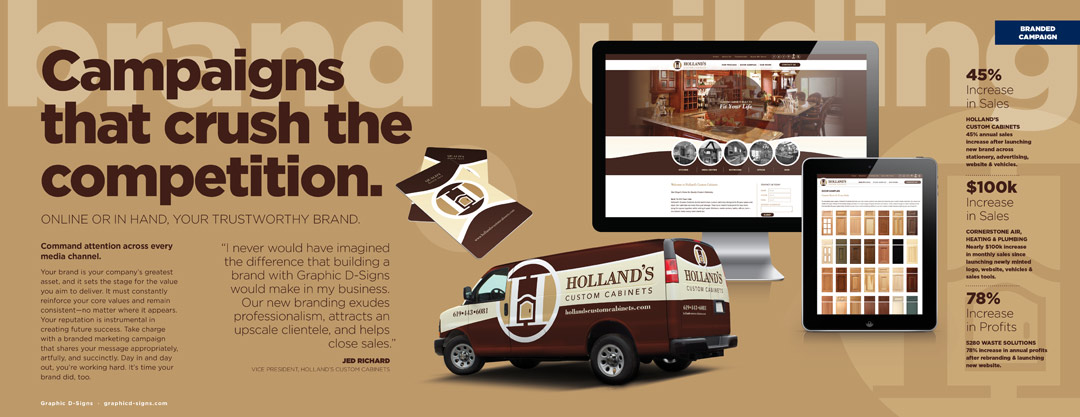
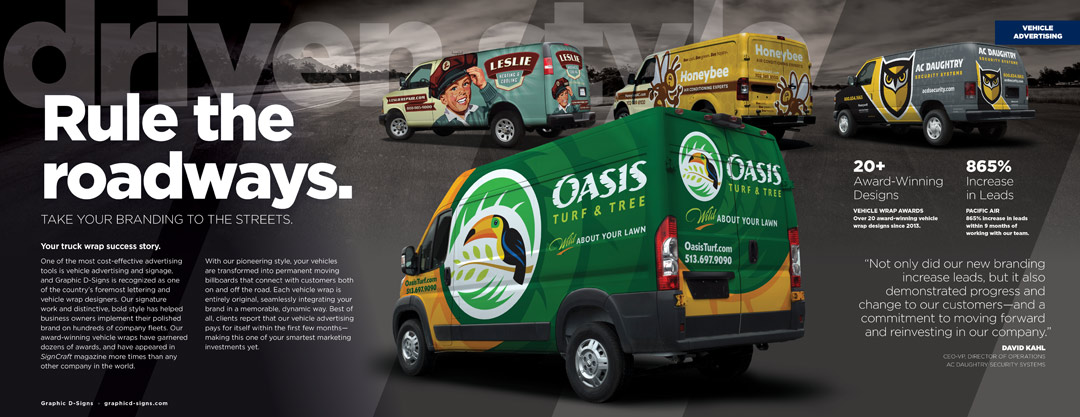
These two spreads from our latest brochure are examples of using case studies to drive home the effectiveness of your work. Comments from satisfied customers and statistics gathered from them go a long way towards showing the benefit of working with you to prospective clients. When your customers say that your designs are successful it carries a lot more weight than when you say that.
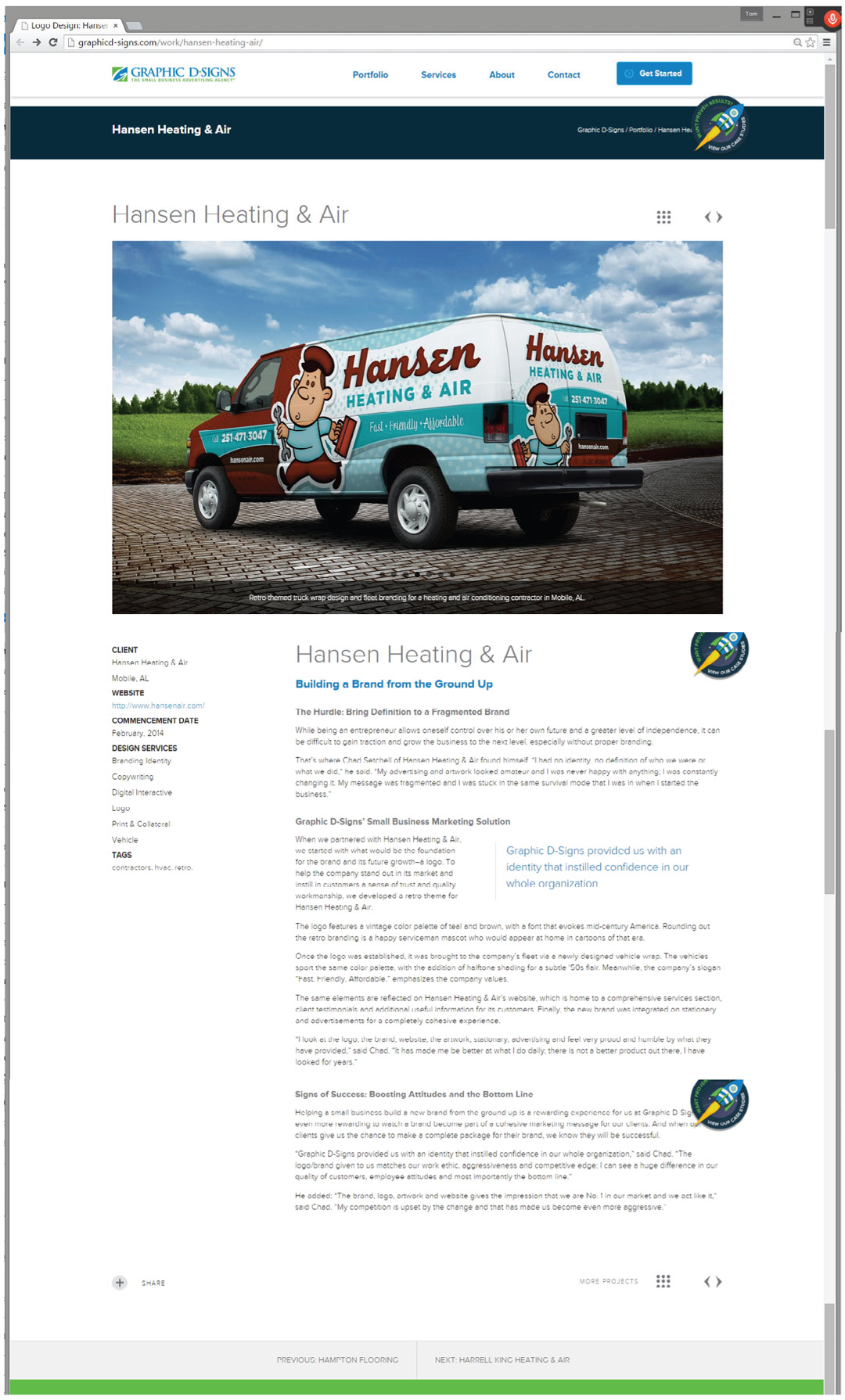
Our website features several case studies that spell out both the concepts behind our design and the results it produced for the client. The image at the top rotates between the designs we did for their vehicle, website, stationery, uniforms and anything else we did to help build their brand.
This appeared in the May/June 2015 issue of SignCraft.

Dan Antonelli owns KickCharge Creative (formerly Graphic D-Signs, Inc.) in Washington, New Jersey. His latest book, Building a Big Small Business Brand, joins his Logo Design for Small Business I and II. He can be reached at dan@kickcharge. com. Dan also offers consulting and business coaching services to sign companies. For more information, visit danantonelli.com. On Instagram: @danantonelli_kickcharge.

