
By signcraft
Posted on Saturday, February 14th, 2026

While most sign makers find the process of creating and producing signs interesting and exciting, they would also agree that determining what to charge for these signs can be challenging. Many a sign maker has wished for a way to know what a shop like theirs, in a market like theirs, might charge for a certain sign.
Overhead varies from shop to shop so a “One-size-fits-all“ approach doesn’t really work when it comes to pricing signs. That’s what makes the Sign Pricing Guide unique. It gives you prices for common types of commercial signs, each priced in three versions: Basic, Intermediate and Complex. The prices you see are based on what other successful sign shops with overhead comparable to yours are charging, coupled with research on overhead and production costs.
While the Sign Pricing Guide is a big help, it’s not a replacement for a fundamental understanding of what it costs you to produce a sign. It’s actually built on that.
If you don’t already know your overhead—the indirect costs of running your business before you buy any materials to make a sign—start with “How to Determine Your Hourly Rate.” It will help you understand your overhead and how it relates to your pricing.
So where do the prices come from? SignCraft surveys established, successful sign shops from coast-to-coast, asking what they charge for specific jobs and what their shop rates are. We also gather job-costing figures to determine how much time and materials were involved in producing certain signs. From this data, we determine the pricing, using four hourly rates that reflect varying overhead and markups.
The Sign Pricing Guide is easy to use. You choose the type of sign, your hourly rate, the approximate dimensions and the level of complexity. Here’s how it works:
First choose your shop’s hourly rate
The prices for each of the different types of jobs—banners, overlaid plywood signs, vehicles, etc.—are given in four color-coded charts. For this guide to be of help, you must choose the pricing level that best fits your hourly shop rate. That shop rate must be based on accurate knowledge of your overhead.
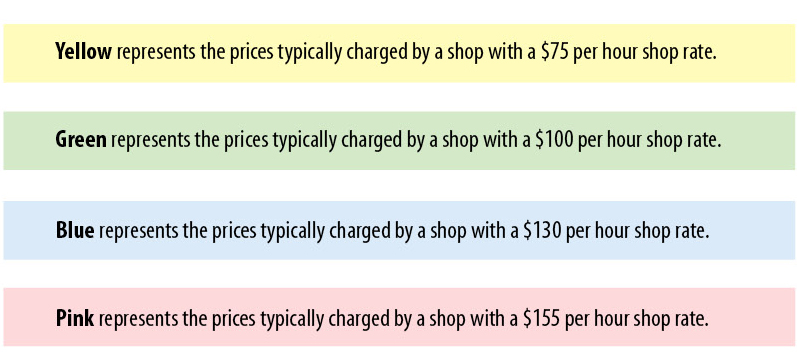
The material markup also increases with each level. In our research, we found that shops with higher hourly rates also generally used a higher markup on their materials. (The cost of waste, handling materials and keeping them in inventory must be recovered, and that’s what material markup is for.)
If you have already determined your hourly rate, use the Sign Pricing Guide to price a few typical jobs that you’ve done recently. Are your current prices close? If not, you may want to review your overhead and your weekly billable hours to make sure your rate is accurate.
Carefully track the time and materials on a few typical jobs. You may find a few things that are sapping your profits. Of course, this is only a guide to help in successful pricing. It’s not intended to be last word on what signs should sell for.
Overhead is the culprit
How can hourly rates of sign shops range from $75 to over twice that? You can blame the beast called overhead for much of that. Rent is a good place to start. The rent in a major metropolitan area can be five times that of the same space in a small town. Even in a smaller town, rent in a high-traffic area can be much higher for the same size shop space.
The other issue is an accurate knowledge of your total overhead costs. Many shop owners don’t have a clear picture of what it costs them to operate their business. These costs are higher than any of us would like them to be. Often they have crept up over a few years almost without us noticing. You may note, though, that you’re working harder to make about the same.
The proof of whether you know your costs is in your bottom line. If you’re working reasonable hours, making a fair wage and seeing a fair profit on the time and money you’ve invested in your shop—and for the risk of being in business—then your prices are adequate. If not, something is amiss, and only taking a look at your costs will reveal it.
What our surveys tell us
In our pricing surveys, we found most shops that listed an hourly “shop rate” they used in their pricing fell close to the four levels shown here. The prices of some of the respondents’ fell in the category above or below what they considered their hourly shop rate. Depending on a shop’s efficiency, that’s surely possible. Again, if that happens to you, do some careful job costing to make sure you’re not missing anything. Then double-check your overhead to make sure everything is covered.
Interestingly, among the surveyed shops, there was no strong correlation between prices and market size—except that metro and tourist areas were all in the highest bracket. In almost every market there are shops that successfully charge more than others. That’s probably because they market some aspect of their work—their design skills, their quality, and their service—more effectively. How you market and sell your skills is a big factor in the bottom line.
Many other small businesses—from advertising agencies to auto repair shops to heating/cooling companies—deal with overhead that is similar to sign shops and do their pricing from an hourly rate. Compare your shop rate to other businesses like these in your market to see where you stand. It can be an eye-opening exercise.
But custom sign work shouldn’t be sold as a commodity like lawn service or air conditioning repair. Unlike these products, the sign shop’s ability to add value is a key factor in the benefit such sign work has to the client. If your shop is capable of delivering this extra value and can demonstrate that to the client, your prices should reflect that extra value.
Choose the level of complexity
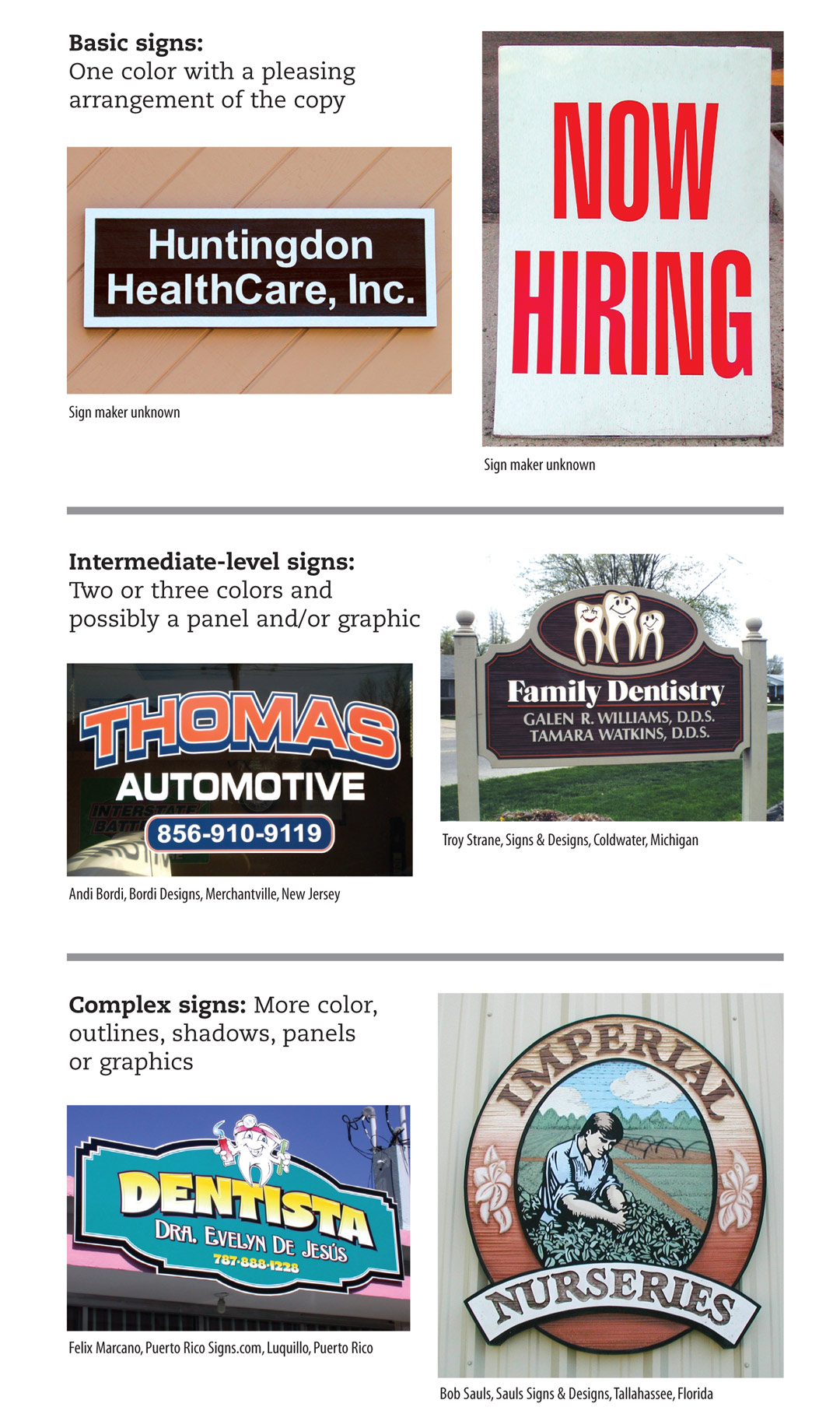
Most categories are broken down by level of complexity: Basic, Intermediate and Complex. Here’s what each level means:
Basic: Pleasing arrangement of the copy, usually in one color on a white background and produced as efficiently as possible for a customer on a limited budget. These are typically informational signs with a minimal amount of copy and not very sophisticated in layout. Such jobs use the minimal amount of materials and time required to produce a clean, informational sign.
Intermediate: Two colors and possibly a panel, border and/or a simple graphic. There’s a little more time for layout and production here, and the result is a more appealing, more effective sign that has some degree of advertising value. In many shops, this is considered an average job. It may involve slightly more materials than a Basic version—and roughly 50% more production time.
Complex: Three or more colors with outlines or shades, with panels, border or graphic, possibly on a different color background. This level adds in a little more time for layout and production—resulting in a sign with even more appeal and impact. Such jobs involve more materials than an Intermediate version, and about twice the production time of a Basic version of the same sign.
The time required to sell and set up each of these jobs is also increased accordingly, as these steps usually take more time as a job gets more complex. For the basic version, you just take the order, make a few recommendations on-the-fly, then lay it out tastefully—but with minimal production time in mind. Intermediate and Complex jobs require more of your time and input.
Complex sign work is more challenging to price. You have to add for extra design time and manual operations. If you do complex work frequently in your shop, tracking the time and materials on such projects is the best way to learn what this work costs you to produce. The more complex a job is, the more care is required in pricing it. While materials may be easy to estimate, it’s easy to give away time if you’re not careful.
Print? Cut film? Hand letter?
The prices in the Sign Pricing Guide are for those made with the most efficient production method. For most jobs in most shops that means computer-cut vinyl film and/or digital printing. Some use a combination of vinyl film and hand lettering. Every shop has its own preferences and capabilities.
If you’re wondering how the costs of hand-lettered versions of most of these signs would fit into the prices in the guide, some users tell us that hand-lettered signs are best priced using the Intermediate and Complex levels for a given job. If you use the Basic levels, the guide is accurate only if the sign is a very quick one-color job done with one stroke lettering.
Knowing what to charge
To effectively estimate a selling price, you need a thorough knowledge of your overhead and costs, along with an accurate estimate of the production time required to make the sign. If your pricing is based on the facts about your business, you’ll be able to quote a price with confidence. That’s why a sign pricing app can be a big help.
You can opt for the “get what I can” approach, but it’s not very successful. Sometimes you’ll make money and sometimes you won’t—but you’ll never know for sure. You also run the risk of your pricing not making sense to the customer, which can hurt your credibility.
Pricing is science; selling is art
There are a lot of variables involved in pricing and selling signs. Most signs are custom made products. If a customer doesn’t pick up the A-frame you made for “The Mocha Cafe,” it doesn’t have much value to anyone else. Yet, if it increases the café’s walk-in sales by 60 percent, the owner will consider it priceless advertising.
Knowing what to charge for a sign is one thing. Knowing how to sell it for that (or even more) is another. Selling involves building a relationship with the customer, helping them solve a problem and having more than just a low price to offer them. It’s about being able to help them realize what you have to offer.
Not all signs are created equal. A sign maker who has worked at developing his or her layout skills can often produce a much more appealing, more effective layout in the same—or less—time than others can enter the text. This skill adds real value to their signs, and they deserve to be compensated for it. The price of their work should reflect this added value.
Successful shop owners know you must sell a sign based on the value of the product—not time and materials. Improving your sales skills is a big part of running a successful business. Having guidelines for pricing is a helpful tool, but there’s more to do when it comes to effectively selling your work. Time spent developing your sales skills is a wise investment.


